
Climate experts explain how El Nino and climate change are intricately linked, with El Nino delaying monsoon onset and climate change intensifying rainfall. This new reality is altering the Indian monsoon's behaviour, leading to short-duration, high-intensity rain spells, especially in western and northwestern regions.

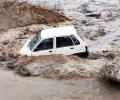
Nepal's devastating flash floods have claimed 1,127 lives, with thousands still missing a week after the disaster. Rescuers are intensifying efforts to find survivors and recover bodies across affected regions, while police work to identify victims and relocate families from high-risk areas.
The head of the UN's climate science panel, Jim Skea, has expressed concern over the accelerating pace of climate impacts, saying scientists have been surprised by the speed of temperature rise. Skea attributed the worsening situation to inaction on climate change and highlighted the need for urgent action to reduce greenhouse gas emissions. He also addressed concerns about the scientific messaging and the perception of imposed climate policies, emphasizing the importance of involving societies and people in climate change action.

Climate scientists warn that climate change is intensifying heatwaves in India, with the cooling effects of La Nia potentially becoming less effective in a warmer future. The India Meteorological Department (IMD) predicts an early summer with above-normal temperatures and intense heatwave spells, following an unusually dry winter and the warmest February since 1901. Experts emphasize the role of human-caused climate change, along with natural climate drivers like El Nio and La Nia, in shaping weather patterns. While La Nia typically brings cooler temperatures, scientists suggest that under climate change, its ability to mitigate heatwaves may be diminished.

The death toll from devastating flash floods in Nepal has surged to 1,252, with more bodies recovered and fresh flood risks emerging due to continuous rainfall in the Bhotekoshi River's upstream areas. The disaster, triggered by an ice-rock avalanche, has also left 4,875 people missing and prompted calls to address climate change's impact on the Himalayan region.

Nepal's former Forest and Environment Minister Madhav Prasad Chaulagain has expressed concern over the lack of timely information exchange with China ahead of the devastating floods, stating that the disaster's scale could lead to an 'unbelievable' rise in the death toll.

'When there is a change in the wind speed or the stress exerted on the surface, it will change the ocean currents.'

Climate change has hampered the ability of the forecasting agencies to accurately predict severe events and weather bureaus across the world are focusing on augmenting the observational network density and the weather prediction modelling to improve predictability, India Meteorological Department (IMD) Director General Mrutyunjay Mohapatra has said.

The DEFRA project with MoEF is yet to identify a research institute in India and the bidding process is to start now, Coyne added. However some green groups in India look at this rush for climate change research in India as a ruse to promote technologies like genetic engineering.

A new study reveals that India's annual gross primary productivity (GPP) increased significantly from 1985 to 2014 and is projected to continue rising until 2100, even under high-emissions scenarios. This enhancement is attributed to stronger precipitation and carbon dioxide fertilisation effects, with the Indo-Gangetic Plain, Northeastern India, and the Western Ghats expected to see the largest increases.

What are the most worrisome aspects of climate change for India? Can they be solved?

The experts said that climate change is not only raising temperatures and making India's heatwaves hotter, but also changing weather patterns that further drive dangerous weather extremes.
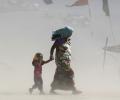
'It is high time that we act instead of just talking about how and why the climate is changing.'
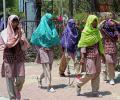
The global body added that national meteorological and hydrological departments in both countries are working closely with health and disaster management agencies to roll out heat health action plans.
How the UN's flagship climate summit lost its direction and what's at stake.

A new report by child rights NGO CRY reveals that nearly seven in every 10 school-going children across India missed school or routine activities from May to June this year due to extreme heat, with 76 per cent reporting negative impacts on their ability to focus on studies.

'The food security along the coastal region will be severely affected.'
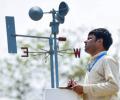
'This system will be of immense help in agricultural planning, disaster management and water resources management.'

Rising mercury levels in Madhya Pradesh are causing sleepless nights for residents as minimum temperatures remain high. Doctors report an increase in sleep-related issues, allergies, and fatigue due to the heat.

Rising mercury levels in Madhya Pradesh are causing discomfort for residents as night temperatures fail to provide relief, disrupting sleep patterns and daily routines.

The monthly average rainfall over India is expected to be below normal during July, the India Meteorological Department said on Tuesday in its monthly forecast.

Unseasonal rainfall could damage standing wheat crops, especially late-sown fields nearing maturity and grain-filling stages.

'We should expect extreme heat, extreme rains, floods, landslides and maybe cyclones. Not just this year, in the coming year as well.'

The year 2024 was not only the hottest year on record but also the first to breach 1.5C above the 1850-1900 baseline.

Above-normal cold wave days are expected in some areas of central India, eastern Uttar Pradesh and Bihar during January 2026.
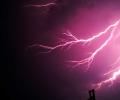
Lightning claims more lives in India annually than any other extreme weather event. Between April and July this year alone, 1,621 people died due to lightning strikes.
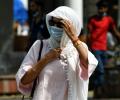
India experienced its second-hottest quarter from June to August this year since 1970, with over one-third of the country's population enduring at least seven days of dangerous heat, according to a new report by a United States-based group of climate scientists and communicators.

IMD data shows in the 24 hours between September 1 and 2, Haryana received 806 per cent more rainfall than normal, Punjab 759 per cent, Himachal Pradesh 510 per cent, Delhi 740 per cent, Chandigarh a staggering 1,638 per cent, and Rajasthan 193 per cent.
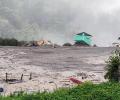
A new study identifies flash flood hotspots in India, highlighting the influence of land features, rainfall, and the growing impact of climate change.

At a virtual press conference to launch the report, Inger Anderson, Executive Director, United Nations Environment Programme, said, "Climate change is here and now. No one is safe. Despite warnings from so many years, the world did not listen. We need to act now. Reducing greenhouse gas emissions will not only limit climate change but also reduce air pollution."
'The intensity and frequency of heatwaves will be much higher than in previous years over Punjab, Haryana, Rajasthan, Gujarat, Madhya Pradesh and Odisha.'

More than twice as much global glacier mass will remain if countries restrict temperature rise to 1.5 degrees Celsius, compared to the warming level of 2.7 degrees Celsius resulting from the current policies, says a new study released.

The winters could be cooler in the plains due to the prevailing La Nina conditions though it does not have a direct relationship and also due to influence of the polar vortex.

The independent group of scientists and communicators previously said that winters are quickly transitioning into summer-like conditions in north India, shortening the spring season.

The World Meteorological Organisation (WMO) has officially confirmed that 2023 is the hottest year on record by a huge margin, smashing global temperature records.

The planet experienced its warmest January on record last month despite the development of La Nia, a climate pattern that usually brings cooler global temperatures, the European climate agency said on Thursday. This comes on the heels of the Earth experiencing its hottest year on record in 2024, also the first to see global average temperatures rise 1.5 degrees Celsius above pre-industrial levels. According to the Copernicus Climate Change Service (C3S), January 2025 recorded an average temperature of 13.23 degrees Celsius, 0.09 degrees warmer than the previous hottest January (2024) and 0.79 degrees above the 1991-2020 average. Scientists also found that the Earth's temperature in January was 1.75 degrees Celsius higher than pre-industrial levels. Global temperatures have stayed above the 1.5-degree mark for 18 of the last 19 months.

Athletes and climate experts have expressed concerns that extreme heat could lead to severe health issues, including the risk of sportspeople collapsing or, in the worst-case scenarios, dying during the events.

He said scientists have noticed a trend of very deep cloud systems developing over the southeast Arabian Sea, and added that sometimes, these systems intrude into the land, like in 2019.

About 57 per cent of Indian districts, home to 76 per cent of the country's population, are currently at high to very high risk from extreme heat.

The India Meteorological Department (IMD) has predicted above-normal rainfall for the upcoming monsoon season in India (June to September). The cumulative rainfall is estimated to be 105 percent of the long-period average. The IMD has also ruled out the possibility of El Nino conditions during the entire season. The monsoon is crucial for India's agriculture sector, which supports the livelihood of a significant portion of the population and contributes substantially to the country's GDP. However, while the prediction of normal rainfall brings relief, climate change is expected to cause variations in rainfall distribution.
